Conformal Coating: Do You Need It, and Which Type?
Humidity, dust and condensation quietly kill electronics. Here is how to tell if your board needs conformal coating, which chemistry to pick and the mistakes to avoid.
Microplacer team · 15 November 2026 · 4 min read
 EMS & Product
A board that works perfectly on your bench can start acting strangely after one monsoon in a roadside cabinet or a few months next to a factory floor. Leakage currents, green corrosion on pins and random resets are often not design bugs at all — they are the environment getting onto the copper. Conformal coating is one of the simplest ways to stop that, but only if you pick it, plan it and prepare for it properly.
What conformal coating protects against
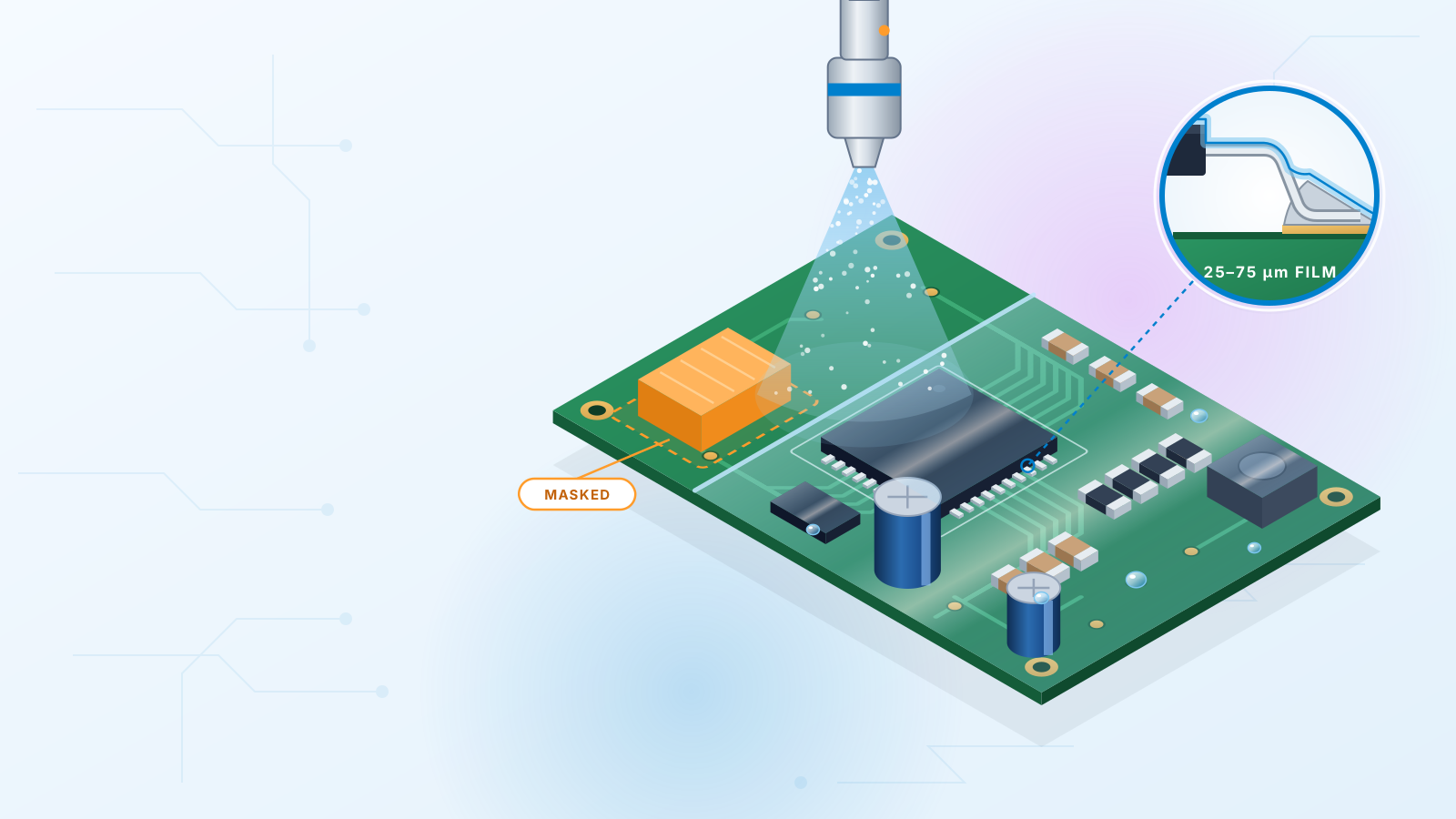
Think of conformal coating as a skin for an assembled board: a thin film that hugs every component body, lead and solder joint, then hardens into a layer you can usually see straight through. It does not replace an enclosure. Its job is to keep the surface of the board clean and dry at a microscopic level, so that moisture and dirt cannot bridge between conductors.
- Humidity and condensation, which can form a thin conductive film between closely spaced pins.
- Dust, fibres and conductive particles that settle between fine-pitch leads.
- Some chemicals, oils and cleaning agents, depending on the coating material chosen.
- Corrosion of exposed copper and solder over the life of the product.
What it is not: waterproofing. A coated board is more tolerant of damp air and occasional condensation, but it is not meant to sit under water or take direct spray. For that, the enclosure, gaskets and cable entries matter just as much as the coating.
Signs your product needs it
Run through this quick checklist. If two or more apply, coating deserves a serious look.
- 1The product goes outdoors, into a basement, a kitchen, a pump room or anywhere humidity stays high for weeks.
- 2It moves between air-conditioned and hot spaces, so condensation forms when it is switched on or carried outside.
- 3It lives in a dusty place — workshops, textile units, construction sites, farms.
- 4It sits near engines, batteries, fuels or road spray.
- 5The board has fine-pitch parts or high-impedance circuits (sensor inputs, references) where tiny leakage changes readings.
- 6Your customer’s drawing or purchase order already asks for it.
In much of India, a board inside a sealed, air-conditioned office may never need coating. The same board in a coastal town, an outdoor meter box or an agricultural controller is a very different story.
Common coating chemistries compared
Every chemistry is a compromise. In practice you are trading how much abuse the film can take against how easily you can strip it off when a board needs repair.
| Type | Strength | Rework | Good fit for |
|---|---|---|---|
| Acrylic (AR) | General-purpose, easy to apply | Easiest to remove | Most indoor and light-duty products, prototypes |
| Silicone (SR) | Flexible, wide temperature range | Possible, slower | Products with big temperature swings, near heat |
| Urethane (UR) | Good chemical and abrasion resistance | Takes more effort | Exposure to oils, fuels or solvents |
| Epoxy (ER) | Hard, tough film | Very difficult | Rugged products where repair is not expected |
| Parylene (XY) | Very thin, very uniform (vacuum process) | Specialised | Demanding applications; plan it early |
For reference, IPC-CC-830 is the usual qualification standard for the coating material itself, while IPC-A-610 sets the acceptance criteria for the coated assembly. If your customer names a specification, start from that rather than choosing a material yourself.
Masking connectors, test points and adjustable parts
Coating goes everywhere it can flow. That is great for solder joints and terrible for anything that needs a metal-to-metal contact. Anything that must stay bare is masked first, using tape, rubber caps or a mask that peels off after curing:
- Connectors, headers and edge contacts.
- Test points and programming pads you will still use.
- Switches, trimmer potentiometers and jumpers.
- Mounting holes and grounding points that must touch the chassis.
- Heatsink contact areas, sensors that need open air, and LEDs or displays where the film could affect the view.
Mistakes to avoid
Coating over dirty boards
Coating sticks only to a clean, dry surface. Flux residue, fingerprints or moisture trapped underneath can cause poor adhesion, bubbles or lifting — and the film can seal the contamination in place right where it does the most harm. Cleaning and drying come before coating, not after.
Ignoring rework needs
Coating turns every later repair into a three-step job: strip the film around the faulty part, replace it, then patch the area with fresh coating. With acrylic that is manageable; with epoxy it can be close to impossible. Finish your testing, firmware loading and any last component changes before coating, and pick a chemistry that matches how often you expect field repairs.
Treating coating as waterproofing
A coated board in an open enclosure facing rain will still fail. If the product will be sprayed or submerged, look at sealing, or at potting — a thick compound that fills the area, gives much more protection and is almost impossible to rework.
Design tips to make coating easier
- 1Group connectors and test points near the board edge so masking is a few simple strips rather than dozens of small islands.
- 2Leave a little clearance around keep-out parts so the mask edge has somewhere to sit.
- 3Prefer connectors with good sealing or that are easy to cap during coating.
- 4Decide coating early, so tall parts, sockets and adjustable components are placed with it in mind.
- 5Note the coating type, sides (top, bottom or both) and any thickness requirement on your fabrication or assembly drawing.
Ready to protect your next build? Our conformal coating page explains the process step by step and what to send us. The instant online price covers the PCB and assembly; coating is priced separately once our team has seen your drawing, so get your board price first and then send the coating details through our conformal coating service page.
#conformal-coating#pcb-assembly#reliability#humidity#rework
Get an instant PCB quote